EQ Resolve
EQ Resolve is in development alongside EQ Wave v2 hardware. This page describes the architectural design and intended capabilities. Contact support@eq.systems for early access discussions.
Purpose
EQ Resolve is the real-time control layer of the EQ Platform. Where EQ Syntropy helps users define control objectives and design strategies, Resolve implements and coordinates those strategies as live control systems — translating high-level objectives (setpoints, schedules, optimization targets) into safe, feasible actions grounded in the electrical state measured by EQ Wave, and monitoring loop performance continuously.
Why Waveform-Level Control Matters
Traditional power meters update at 100 ms to 1 s — yet many power control applications require much faster response. Meanwhile, traditional power quality analyzers treat control-relevant data as a secondary concern, with update rates that may be as slow as 2 s and sometimes non-deterministic.
EQ Resolve operates on CPOW data and derived metrics from EQ Wave, providing:
- Sub-cycle awareness: Detect and respond to events within a single AC cycle
- Deterministic timing: Control loop execution in < 10 ms, independent of cloud connectivity
- Physics-grounded decisions: Every control action validated against real-time electrical constraints, not stale models
EQ Resolve combines full waveform-level awareness with the deterministic response time required for closed-loop control — an unusual combination, since most systems trade off one for the other.
Architecture
Resolve coordinates between EQ Syntropy (strategy), EQ Watch (metrics), EQ Wave (measurement + actuation), and external EMS/partner systems:
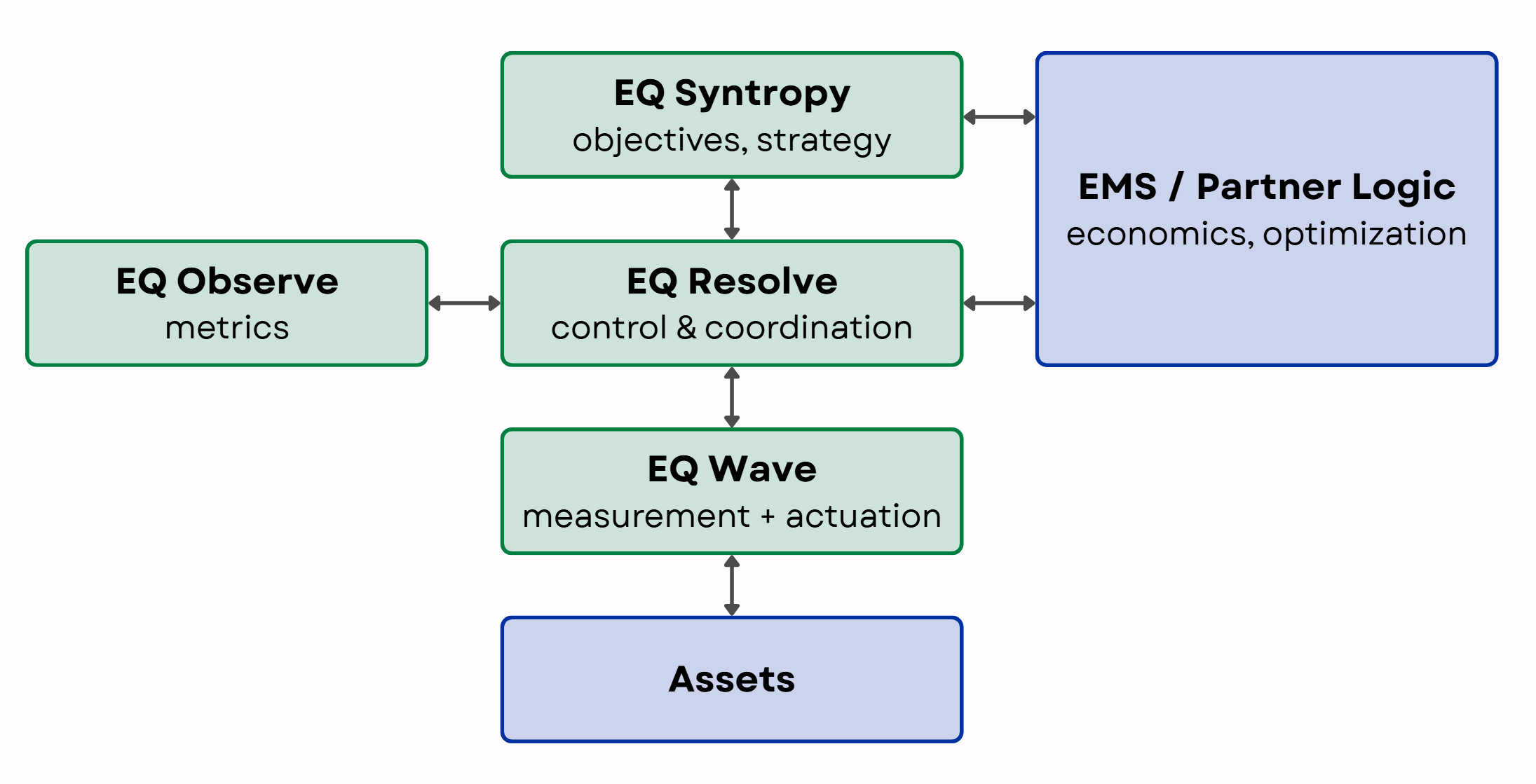
EQ Syntropy helps engineers design control strategies but is not part of the control loop itself. EQ Resolve implements those strategies as real-time control loops, typically executing at the same layer as EQ Watch. Where lower latency or deterministic timing is required, control logic can be pushed down into the EQ Wave device. EMS and partner logic (economics, optimization) interface at both the strategy and control layers.
Key Capabilities
- Real-time constraint enforcement: Validates commands against equipment limits, grid conditions, and safety envelopes before execution
- Deterministic control translation: Converts high-level objectives into stable, time-aligned control actions
- Dynamic reconciliation: Arbitrates between competing objectives, disturbances, or conflicting constraints
- Edge-autonomous operation: Fully functional on isolated or air-gapped networks with no cloud dependency
Target Applications
- Energy storage dispatch: Constraint-aware BESS charge/discharge with real-time feasibility checking
- Microgrid control: Unified sensing and control across solar, diesel, battery, and load assets
- Power factor correction: Closed-loop capacitor/reactor switching based on live waveform analysis
- Voltage regulation: Sub-cycle tap changer or inverter VAR control using CPOW feedback
- Equipment protection: Fast-acting protective responses triggered by waveform-level anomalies
Requirements
EQ Resolve requires:
- EQ Wave sensors (v2 adds lower-latency, deterministic actuation paths via FPGA)
- EQ Watch for data recording and API access
- Linux-based gateway hardware
More Information
- EQ Wave v2 Overview — additional hardware capabilities for Resolve
- EQ Syntropy — control planning, design, and high-level optimization
- Deployment Options — gateway hardware and configuration