EQ Wave v2 Series
This document describes the EQ Wave v2 series currently in development. All specifications, features, and timelines are subject to change. For current production specifications, see EQ Wave v1 Series.
The EQ Wave v2 adds FPGA-based signal processing, configurable sampling rates, complete measurement-to-network isolation, and real-time control output to the existing v1 platform.
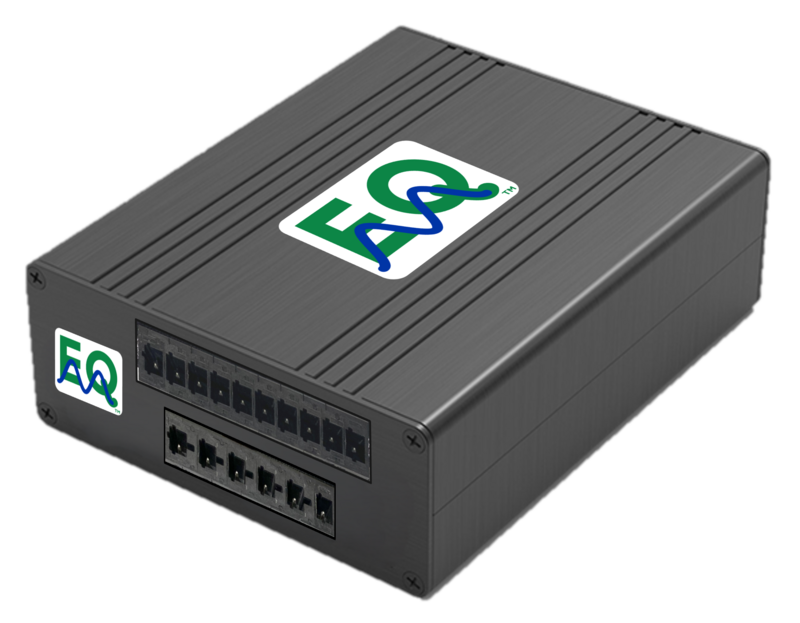
EQ Wave v2: Compact aluminum enclosure with dual network interfaces (conceptual rendering)
Architecture
The v2 architecture centers on a programmable FPGA signal processing pipeline alongside the MCU, enabling application-specific configuration:
- Configurable sampling rates: 4–64 kHz (4–16 kHz for energy management, 32–64 kHz for transient capture and motor analysis)
- Adaptive filtering: FPGA filters configurable per deployment environment
- Deterministic control path: FPGA-to-network path for sub-millisecond control loops
- Software-defined: Sampling, filtering, and control algorithms adaptable by settings or firmware updates
Key Changes from v1
1. Processing: Dual-Core MCU + FPGA
- Dual-core ARM Cortex-M33 @ 150 MHz
- Integrated FPGA for parallel signal processing
- Enables on-device anomaly detection, harmonic analysis, and control logic independent of the gateway
2. Integrated Isolated ADCs with FPGA Processing
- Integrated isolated delta-sigma ADCs with complete 5 kV isolation
- FPGA-based configurable sampling (4–64 kHz)
- Programmable gain (1× to 128×) and oversampling for ENOB optimization (14–18 bit)
Configuration examples by application:
- Energy management: 17–18 bit ENOB at 4–16 kHz
- Power quality monitoring: 15–16 bit ENOB at 32 kHz (IEC 61000–4-30 Class A compliance)
- Motor control / VFD analysis: 14–15 bit ENOB at 64 kHz with < 1 ms latency
One hardware platform serves multiple applications; field-reconfigurable as requirements change.
3. Modular Power Architecture
- Separate DC input and DC output terminals
- Optional AC power supply board (field-installable)
- Optional GPS timing board for multi-site synchronization
- Optional EtherCAT support for industrial automation integration
DC output can power external signal conditioners, relay contacts, or other field accessories.
4. Dual Network Interfaces
- Internal Ethernet switch with dual interfaces
- POF (plastic optical fiber) for electrical isolation AND RJ45 for direct copper connection
- Field-selectable without hardware changes
- Both interfaces can operate simultaneously for redundancy or network segmentation
5. Extended Onboard Storage
- microSD card interface supporting up to 2 TB
- Compression algorithms (in development) targeting weeks to months of continuous waveform storage
- Direct data retrieval via network interface (no gateway required)
This enables standalone deployment as a walk-up fault recorder — connect with a laptop and retrieve weeks to months of continuous waveform history.
Storage capacity examples (continuous @ 64 kHz, 5–10:1 compression):
- 512 GB: 3–6 weeks
- 1 TB: 1–3 months
- 2 TB: 2–6 months
Cost context: Traditional fault recorders cost $5,000–15,000 with days/weeks of storage. EQ Wave v2 targets $2,000–3,000 (depending on configuration) with weeks to months of continuous waveform archival.
6. Aluminum Enclosure
- Aluminum housing replaces polycarbonate
- Better EMI/RFI immunity (critical near VFDs, welders, RF transmitters, medical imaging)
- Improved thermal management and mechanical protection
- DIN rail mounting: 90 mm flat or 36 mm on edge for high-density installations
Application Notes
Semiconductor fabrication: FPGA processing detects and characterizes transients < 10 μs, supporting preventive action before wafer damage.
Data centers: Real-time pattern recognition identifies pre-failure electrical signatures in power distribution equipment ahead of critical failure.
Electric utilities: GPS-synchronized monitoring enables coordinated voltage regulation and load balancing across distributed substations.
Industrial automation: EtherCAT integration enables coordinated power conditioning control with deterministic < 1 ms latency.
Comparison: v1 vs v2
| Capability | v1 Series | v2 Series | Notes |
|---|---|---|---|
| Processing | Single-core M4 @ 120 MHz | Dual-core M33 @ 150 MHz + FPGA | FPGA enables on-device analytics |
| Sampling | Fixed 32 kHz | Configurable 4–64 kHz | Application-specific optimization |
| ENOB | Fixed (~16.5 bit) | Configurable 14–18 bit | Trade resolution for speed or vice versa |
| Isolation | Front-end only | Full 5 kV measurement-to-network | Enables in-panel installation at voltage source |
| Power | Combined AC/DC input | Separate DC I/O + optional AC board | Field-configurable |
| Network | POF only | POF + RJ45 (dual interface) | Simultaneous or selectable |
| Enclosure | Polycarbonate | Aluminum (extruded) | EMI immunity, thermal performance |
| DIN Width | 90 mm | 90 mm flat or 36 mm on edge | High-density option |
| Optional Modules | GPS (not connected) | GPS, EtherCAT, AC PSU | Add capabilities as needed |
| Edge Processing | Limited | Dedicated FPGA | On-device anomaly detection and control |
Development Status
The v2 architecture is fully specified: major components selected, PCB factored, and aluminum enclosure designed. Production prototyping and manufacturing scale-up are contingent on customer commitments or funding.
Design milestones completed:
- Component selection and architecture validation
- PCB factoring and enclosure mechanical design
- Firmware architecture and FPGA integration plan
- BOM costing and supply chain sourcing
Next steps:
- PCB layout and prototype assembly
- Bench testing and design validation
- Firmware migration and FPGA pipeline development
- Pilot deployments with early customers
- UL/FCC certification
Engagement
We are seeking partners for early adoption and co-development:
- Mission-critical facilities where power quality directly impacts operations
- Applications requiring specialized capabilities (GPS sync, EtherCAT, high-speed transient capture)
- Organizations with in-house power quality expertise for technical feedback
Contact: support@eq.systems with subject “EQ Wave v2”